
Townhome vs high-rise apartment living in Austin: how to choose
By Ross Quade · Updated 2026-06-06
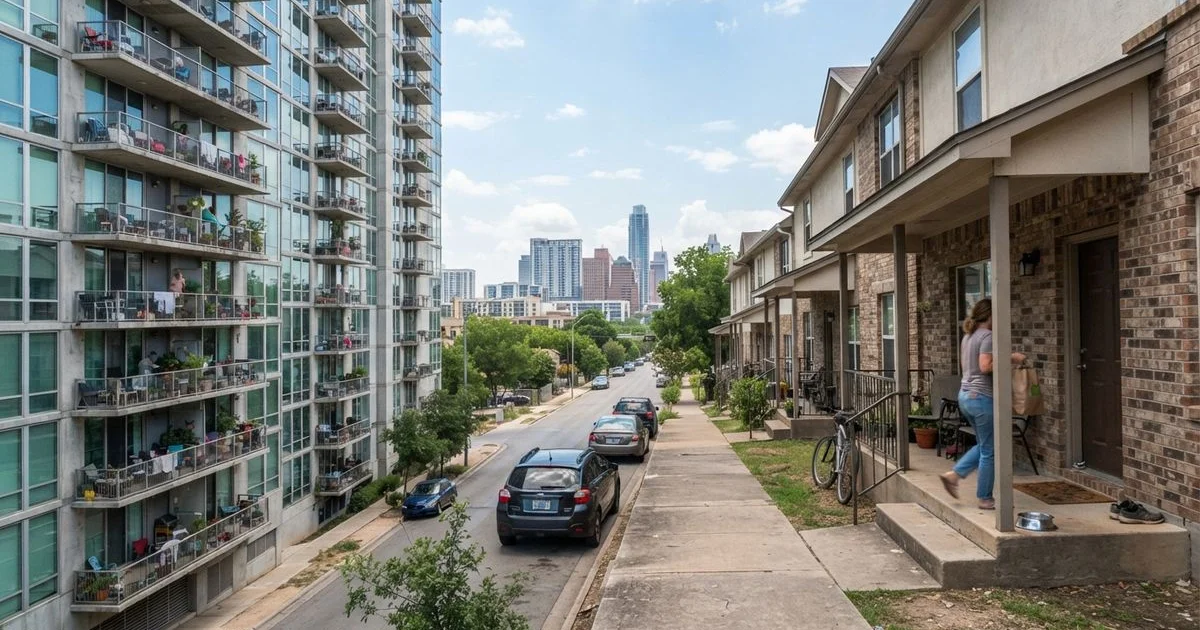
Choosing between a townhome-style community and a high-rise apartment in Austin comes down to a real lifestyle tradeoff, not just a price comparison. Our townhome and garden-style community listings across Greater Austin are a useful starting point if privacy and outdoor space matter more to you than a downtown view, but it helps to weigh the tradeoffs directly before deciding.
The core tradeoffs
| Factor | Townhome / garden-style | High-rise |
|---|---|---|
| Privacy | Fewer shared walls, often a private entrance | Shared hallways, elevators, more neighbors per floor |
| Noise | Generally quieter unit-to-unit, but wood-frame construction can transmit some sound | Concrete construction often reduces unit noise, but hallway and elevator noise is common |
| Outdoor space | Often includes a patio or small yard | Typically shared rooftop or courtyard space only |
| Parking | Frequently direct-access or attached | Usually structured garage parking |
| Amenities | Community pool, clubhouse, dog park | Often more extensive: fitness centers, coworking space, concierge |
| Commute and walkability | Varies, often suburban or lower-density areas | Frequently central, closer to downtown employers and nightlife |
Where townhome-style communities win
If you want a private entrance instead of a shared hallway, direct access to your own small patio or yard, and a quieter day-to-day feel, a townhome or garden-style community is usually the better fit. These communities also tend to sit in lower-density parts of the metro, which can mean a longer commute to central Austin employers in exchange for more space and privacy.
Where high-rise living wins
If proximity to downtown, a shorter commute for a central-Austin job, and a fuller amenity package (concierge service, extensive fitness facilities, rooftop common areas) matter more to you than private outdoor space, a high-rise is usually the better match. Concrete high-rise construction can also mean better unit-to-unit sound isolation than a wood-frame townhome building, even though hallway and elevator noise becomes more of a factor.

Cost is not a simple rule
It is a common assumption that high-rises always cost more, but this depends heavily on the specific location and amenity level rather than the building type alone. A high-rise further from the urban core can price similarly to a townhome community in a more central location. Compare actual quotes for the specific neighborhoods you are considering rather than assuming one building type is categorically cheaper.
Life stage matters as much as building type
Families and anyone with a dog often lean toward a townhome-style community for the yard space and easier ground-floor or near-ground access, while young professionals without a car-heavy lifestyle sometimes prefer a high-rise specifically for the walkability to work, restaurants and nightlife. Neither is a universal answer. Someone who works from home most days may value a quiet townhome with a private patio far more than someone who is only home to sleep and wants the building’s amenities and location to do the heavy lifting.
What to check on a tour, regardless of type
Whichever direction you lean, ask to see the specific unit you would sign for, not just a model. In a townhome-style community, ask about shared wall placement and whether your unit backs up to a parking area or a quiet green space. In a high-rise, ask about elevator wait times during peak hours and how far your unit is from the elevator bank and trash chute, since both affect daily convenience in ways a floor plan alone will not show you.
Questions to ask yourself before deciding
Do you actually use extensive amenities like a fitness center or concierge, or would you rather have your own patio? Is your daily commute destination closer to a high-rise-heavy area or a lower-density part of the metro? How much do quiet, private outdoor space and fewer shared walls matter to your day-to-day routine, versus walkability and a fuller amenity package?
Touring both types before deciding
If you are genuinely undecided, tour one of each before signing anywhere. The difference between a townhome’s private entrance and a high-rise’s shared corridor is hard to fully appreciate from photos alone, and a short in-person visit to both often makes the decision clearer than any comparison chart. Our guide on what to expect when touring an apartment complex covers what to bring and ask at both kinds of tours. Our methodology explains how we score and vet the communities in this directory, and Austin Apartment Reviews Guide lets you compare resident reviews across both community types before you commit.
Frequently asked questions
- Is a townhome-style apartment quieter than a high-rise?
- Generally, yes, especially a townhome with a private entrance and fewer shared walls. High-rises can transmit hallway and elevator noise, though concrete construction in many high-rises actually reduces unit-to-unit sound transfer better than wood-frame townhome construction.
- Are high-rise apartments more expensive than townhome-style communities in Austin?
- It depends heavily on location and amenities, but high-rises in central, high-demand areas often command a premium over garden-style or townhome communities further from the urban core, for a comparable unit size.
- Do townhome-style communities have less parking hassle than high-rises?
- Often yes. Many townhome and garden-style communities offer direct-access or attached parking, while high-rises frequently use structured garage parking that can mean more walking or waiting, especially in a busy building.
- Which is better for someone who wants outdoor space?
- Townhome-style communities typically win here, often including a small patio, yard or private entrance, while high-rise living generally trades private outdoor space for shared amenity areas like a rooftop deck or courtyard.